
Kensuke’s Kingdom (Stuart Hancock)
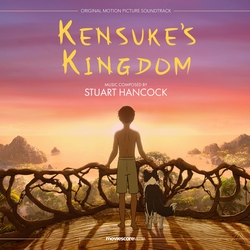
Earworm – a recurring tune that involuntarily pops up and sticks in your mind. Usually they are catchy tunes, popping up spontaneously or triggered by emotions, associations, or by hearing the melody. Do you like earworms? Do you like melodies that hop on the musical merry-go-round in your head and refuse to get off? Oh boy, then Stuart Hancock has got you covered.
Directed by Neil Boyle (The Last Belle) and Kirk Hendry, Kensuke’s Kingdom is a wonderful and inventive animated film about a young boy (Michael, and his dog) who washes up on a remote and seemingly deserted island, after he is swept overboard and separated from his family during a family sailing trip. Of course, he is not alone on this island and he soon meets Kensuke, who is stand off-ish at first, but soon the two become friends. Despite their language barrier, Michael learns of Kensuke story. It’s a this point that the adventure movie gains a whole new, poignant level.
The original score was written and orchestrated by Stuart Hancock (The Last Belle, Crazyhead, We’re Going On a Bear Hunt, Atlantis, ITV’s This Morning theme and the Pampers Poonami advert). His score is avdenturous, whimsical, colourful, poignant and memorable. It’s everything that I want from a film score; and it very reminds me of the playful adventure scores of the 1990s by composers like Joel McNeely, John Debney and perhaps Alan Silvestri. It’s got a similar kind of energy as some of my childhood favourites like Iron Will or White Fang and I’d probably throw Michael Kamen’s The Iron Giant and Daniel Hart’s Pete’s Dragon in there as well.
We begin our musical journey at “The Peggy Sue”, in which Hancock introduces the main theme. It’s lush and bold, lead by brass and accompanied by, well, the entire orchestra. There’s a moment where it travels from the horns to the trombones, and it’s so awesome! Yet, throughout the score we’ll discover just how malleable and versatile this theme really is, as it is performed in many variations. I don’t know for sure what measure Hancock used, but I’m going to assume it’s a straight 4/4 and the whole theme is eight bars long. But it’s built from four sections, each two bars long. Throughout the score Hancock will break those sections and play with them as necessary to suit the storytelling. To me, that’s a sign of a great theme. Not only does it work in different orchestrations and different moods, but you can litterally break it apart and reconstruct it.
“Exploring the World” briefly reprises the main theme accompanied by a flurry of light strings and woodwinds; and I must note that the woodwind writing throughout the score is pure bliss and actually reminds me of classic Disney scores where it would accompany fluttering birds and the like. This cue also introduces a second, simple and gentle theme for only four notes, and it seems to represent family. “Man Overboard” kicks it in another gear as Michael get himself and his dog in peril, but the family pull together to save the day.
“Travelogue” is a jubilant cue and frankly one of the most exciting individual cues I’ve heard in a long time. A jaunty rhythm supports a busy, scatty tune before the main theme makes a triumphant appearance. There is more detail, clever writing and sensational orchestrations in these two minutes than I’ve heard in many a full score. That playful tune, let’s call it “the travelling theme” is sensational. Hancock uses call-and-answer technique to great effect, not just here but throughout the score. The woodwinds are having a blast and tie the various elements of this cue together. There’s a great little trombone run before “the travelling theme” kicks in. The bridge from this theme to the main theme is a sort-of deconstructed, half tempo version of the main theme. Hancock uses this a few more times throughout the score. When the main theme kicks in properly, Hancock stretches it out a bit by by adding a couple of beats to each section of the theme. Again showcasing how flexible it is. Not to mention there are some lovely, unexpected harmonisations. These are all ‘little’ things that many composers wouldn’t think about, or would deem not strictly necessary for the movie, but they do hugely elevate the music and enhance the storytelling.
After a turbulent “Storm”, the score deals with young Michael being separated from his family, stranded on a seemingly deserted island and learning to cope with his new situation. These cues range from subdued to low-key playful. And then “Kensuke Appears”. This scene is wonderfully executed, with Kensuke slowly emerging, ghost-like, through the smoke of a smoldering camp fire. The writing here is dark, mysterious, with great use of choir evoking memories of Ligeti.
After a cold introduction, Michael and Kensuki slowly become friends, despite neither speaking each other’s language. The film is absolutely wonderful in how it portrays both these people’s background stories. The music is gentle and warm, with lovely magical touches in cues like “Kensuke’s Home” and “Finding the Logbook”. When we learn of Kensuke’s history in “Nagasaki”, it is accompanied by a children’s lullaby, dramatic chanting (reminiscent of “Navras” from Don Davis’ The Matrix Revolutions) and more choral glisandi effects. The vocals are actually a traditional folk song about the beauty of cherry blossoms. A poignant memory of home for Kensuke, I assume.
Now entering a new phase in Michael’s and Kensuke’s relationship, the score has a new spring in its step, as per the colourful and vibrant “Kensuki and Michael”. However, new perils loom on the horizon. “into the Jungle” is mysterious with a sorrowful male vocal (Ken Wanatabe) singing a simple tune that I think represents Kensuke and that returns a few times in the remaining cues. And “The Hunt” is a menacing three-part cue with lamentful vocals, and impressive action-writing. As I wrote earlier, I believe the music has much more in common with 90s adventure scores than current ones. There are moments in these “Hunt” cues that superficially remind me of Joel McNeely.
“Healing” has Michael (actor Aarom MacGregor) singing Kensuke’s melody, a bit hesitantly as first as if he’s learning the tune, but when Kensuke joins in, Michael’s voice becomes more confident. The orchestra joins in, takes over and soars. As all good things must come to an end, as Michael’s family finally finds him and it’s time to say “Sayonara” to Kensuke. Unsurprisingly this cue is pure gold. Over the course of five minutes it covers a range of emotions: it’s sad, it’s uplifting, it’s poignant, it’s jubilant. The score closes with a rousing and infectious “End Titles” cue mostly made up from various earlier cues (e.g. “Travelogue”, “The Peggy Sue” and other bits).
I’ve been following Hancock’s career for a few years now and have loved many of his scores, but Kensuke’s Kingdom is on a whole other level. It is inspired, it is magical, it is so good, even at the little details. If this was written by one of the Hollywood regulars, the internet would be on fire by now (aside from the fact that Hollywood regulars don’t write in this style anymore). Hancock delivered a score that is so well thought-out, with great themes and wonderful orchestrations. With a sense of adventure, longing, playfulness and empathy; and with great storytelling. It is performed with passion and enthusiasm by the Bratislave Symphony Orchestra and Holst Singers, with a crisp yet warm recording (Adam Smyth, Mikael Carlsson, Martin Roller), and presented beautifully (Movie Score Media). Kensuke’s Kingdom is Stuart’s Triumph.
Article by Pete Simons (c) Synchrotones 2024

 Synchrotones' Soundtrack Reviews
Comments are closed.