
Here (Alan Silvestri)
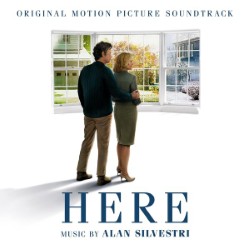
Much has been written about the film Here. I mean, not here, but elsewhere. Sadly, very little of it sounds positive. The static camera gimmick, capturing everything that happens in a single spot throughout time, from dinosaurs trampling around it to folk building a house around it so we can see what happens in their living room, seems to have fallen flat with most critics.
I think it’s a daring move (or lack thereof). Some critics say it feels more like an art installation, to which I’d say, then let’s look at it like that. Music for Robert Zemeckis’ latest visual marvel is, of course, by long-time collaborator and soul mate Alan Silvestri. The pair has been working together since Romancing the Stone and, as if it needs any further introduction, also worked on the Back to the Future movies, Who Framed Roger Rabbit, What Lies Beneath, The Polar Express and a few others that will get mentioned later on.
Silvestri utilises a handful of core themes and motifs. The most instantly attractive is the lush, long-lined main theme as heard in “Opening” and recurring in “This is Here”, the last few seconds of “I Think She’s Gonna Leave Me”, “I’m Gonna Sell the House” and “I Love it Here”. It’s a beautiful, romantic, wistful melody akin to something Rachel Portman might write. It sounds fragile and tender on the piano, yet feels robust when given the full orchestral treatment. As the melody moves forward and the harmonies become richer, it feels poignant and it really carries the weight of the movie’s big idea.
Comparisons to Forrest Gump and Contact are inevitable, obvious and justified. Here relies on a piano-and-strings arrangement as much as those two formidable scores. An occasional lone woodwind recalls Castaway. The free-flowing, unashamedly romantic style of the main theme also reminds me classic Silvestri’s scores like Father of the Bride. Younger audiences might think it’s old-fashioned and saccharine. This is what filmmusic sounded like in the 1990s. So it’s perfect for middle-aged folk like me.
“Why Am I Here” introduces a second theme, a five-note motif intially for piano; four ascending note, and the fifth dropping down. This one is more fleeting, it feels questioning and uncertain; and it reminds me a little of early James Horner in super-intimate mode. It returns in “God Help Me”, “Sell the House” and towards the end of “The Great Flood”. “Necklace of Shells” contains a variation where the five notes are in a different order, but I think it’s fair to call it a variation rather than a different motif. In this cue, as well as “Circle of Life” and “The Necklace” the motif receives an extension in the form of another five-note motif which will sound familiar to Silvestri fans. It’s a big Silvestri-ism, and instantly reminds me of cues like “Pandora’s Box” from his Tomb Raider score or “Reunited” from Van Helsing. There’s a simple yet stunning melancholy theme in “Sell the House”. I’d say it’s a slow three-note motif that plays and moves around in the woodwinds whilst strings eb and flow in the background. This one really hit me in the feels.
And there’s a bit of action material too! I wasn’t expecting this, but “Extinction” and “The Great Flood” provide a few opportunities for Silvestri’s to apply his typical muscular action writing. Strings arpeggios, stabbing brass chords and a fluid 6-note string motif are the key ingredients here. “Mammoth” opens with big brassy chords, though quickly dissolves into a variation on the second theme. Especially here, as its performed on piano, moving through different harmonies and with a sort-of abstract background, it reminds me of old-fashioned Silvestri, perhaps Shattered, The Bodyguard, that kind of era.
As a massive Silvestri-fan, of course I’m biased, though I have to admit that we’d have to go back quite a few years to find another score of his that I enjoyed this much in its entirety. The Witches, Marwen, Ready Player One, The Walk all had their moments. More specifically they all had spectacular themes. Here has a spectacular theme and is a bliss to sit through from start to finish (its tight 40-minute runtime helps in this regard). It’s unequivocally a Silvestri score with plenty of his tropes, but it’s never too close to his previous works (I’m looking at you Marwen).
There isn’t much I could fault here. There’s a tempo change towards the end of “I Love it Here” that took me a few times to get used to. And speaking of tempo, the action music in “The Great Flood” feels a bit slow. The same material plays much faster in “Extinction” and feels more natural at that pace. That said, if I have to resort to the tempo of certain cues to find anything to critique than I think we’ve got a pretty solid score on our hands! Still for me, it’s not quite up there with the very best of Silvestri. It’s beautiful, it’s memorable, and if I still dished out ratings I’d give it a solid four, maybe and a half. But it also feels very, very safe. It’s gorgeous but predicatable. It lives up to expectations, but, other than the main theme, doesn’t quite exceed them. Perhaps that’s me setting the bar too high, because really this is one of the best scores of the year. All the themes and motifs are combined (probably edited rather than composed) in the 8-and-a-half minutes “End Credits”. If nothing else, I urge you to listen to this suite; and I’m sure it’ll leave you wanting more. So, Here it is! (15 tracks, 40m)
Article by Pete Simons (c) 2024 Synchrotones

 Synchrotones' Soundtrack Reviews
Trackbacks & Pingbacks
Comments are closed.