
Gladiator II (Harry Gregson-Williams)
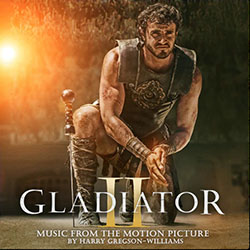
For me Gladiator did not need a sequel. It’s one of my all-time favourite movies, and as much as I didn’t want that movie to end, it came to a poignant and brave conclusion. Yet here we are. Nearly twentyfive years later and of course I’m excited, if cautiously. I remember going to the cinema, back in 2000, and seeing Ridley Scott’s masterpiece. ‘Seeing’ doesn’t do the experience any justice. I saw it, heard it, felt it, experienced it. Man alive; it was, and still is, brilliant.
Hans Zimmer’s score for Gladiator was something else back then in 2000. It was more classical than I dared hope for at the time. It winked at Holst and give a nod to Wagner. It was memorable. And the collaboration with Lisa Gerrard was a stroke of genius. It added a new agey and slightly popular edge. Whilst I do think that the sound of the Gladiator score has aged a bit, due to Zimmer’s use of synths and his particular production style, the main theme endures. One might say, it echoes through eternity.
With Zimmer not returning to score Gladiator II, Harry Gregson-Williams is the only credible composer to take the reigns. Unless you are a filmmusic newbie, HGW’s assignment should not surprise anyone. Still, for those who joined our niche little passion (welcome!), Harry Gregson-Williams has worked with Ridley Scott previously, notably on The Last Duel, Kingdom of Heaven and The Martian and also sort-of came to the rescue on a few scenes of Prometheus. HGW, we abbreviate his name so to save half an hour typing it all out, also worked with/for Hans Zimmer in the 1990s on scores like The Rock. It was Zimmer who suggest that HGW team up with John Powell on Antz; and the pair reunited for Shrek and Chicken Run. Since those 90s and early 2000s days, after leaving MediaVentures, both HGW and Powell have become incredibly successful and popular composers. Powell mostly in the world of animation, with HGW’a focus more on electronic-heavy action as well as orchestral adventures.
Harry Gregson-Williams formed a strong relationship with Tony Scott (indeed Ridley’s brother) and scored seven of his movies including Enemy of the State, Spy Game and Man of Fire. The composer matched the director’s frenetic style with edgy electronics, but he showed off his orchestral skills on movies like Sinbad: Legend of the Seven Seas, the Shrek sequels and the Chronicles of Narnia.
In a way, Gladiator II sounds like the culmination of all that HGW can do. It is predominantly an orchestral score, quite a powerful one at that, with choir, but also with the infamous electric cello and other ‘unnatural’ sounds. There are moments where it sounds like the lovechild of Gladiator, Spy Game and Black Panther. It is at times incredibly forceful, arguably the most aggressive I’ve ever heard HGW be.
Of course Zimmer’s original theme is present. HGW does a grand job incorporating it into his score. I assume he knew from the very beginning that that theme would have to be there. It feels like a natural part of the score, as if the composer derived (at least some of) his music from that theme. There are other elements from the original that HGW reprises, such as Lisa Gerrard’s vocals and certain eerie, wavering flute textures.
The first time, on the album, that we hear the Gladiator theme in full is in “Strength and Honour”. This is such a brilliant cue, and a great representation of HGW’s work. It starts with dark, menacing chords that eb and flow whilst a male choir chants in the background. The dark chords here are key to HGW’s score. Slowly the music builds, the harmonies are shifting, they are searching, until they hit upon the Gladiator theme and it all falls into place like a glorious musical puzzle. From 1:44 shivers run from the top of my head down to my toes, leaving a trail of goosebumps behind. This is a wonderful, transformative cue, with those strings and brass swirling around until they form the theme.
“Strength and Honour” shows the genius of HGW, but admittedly also highlights his ‘curse’ and probably the reason why Zimmer himself didn’t want to score this movie. In an interview Zimmer said he has “done that world and done it well” (yup, that’s true, to be fair) and he feared that comparisons where never going to work out favourably. HGW faces not only that exact same issue, but also short-sighted hardcore fanboys crying out that “if it’s not Zimmer, don’t bother”. The original score was, well, original and incredibly popular even with mainstream audiences. That’s almost impossible to replicate. Not to mention, I don’t know about you but I want to hear the Gladiator theme. And so the most memorable moments of HGW’s formidable score are those where he quotes Zimmer’s theme. I guess it was inevitable. On that note, there’s a gorgeous, heartfelt rendition of it towards the end of “I See Him In You”, and an epic finale in “The Dream is Lost”. And there’s a wonderful build-up to it in “Echoes in Eternity” and then cruelly doesn’t actually go all the way.
There are only very few composers I would’ve trusted with this project. HGW knows Zimmer’s style inside-and-out, so is capable of creating a score that feels similar, like it belongs in that universe without feeling pastiche; and he is a formidable composer who can add his own ideas to this universe. So let’s talk action music, shall we? There’s plenty of lively percussion in cues like “Angry Babboons” and “Defiance” (also note the swirling strings here). There are aggressive, staccato string performances, sometimes combined with growling brass (“Overture”, “Ostia”, “Macrimus’ Plan”). There’s an ancient (Iberian) horn that frequently calls and sounds terrifying, recorded with Abraham Cupeiro. There’s plenty of wonderful exotic woodwind material, electric cello and violin, which is such an iconic HGW and MediaVentures sound. I actually love hearing it here; it feels like an old friend. And then there are vocals. Lisa Gerrard is back, though far from as prominently as before. In fact it wouldn’t have surprised me if HGW re-used her original recordings, but a press statement indicates they are new recordings. Gerrard’s voice was closely linked to Maximus and his desire to reunite with his family in Elysium. Seeing as G2 tells a new story, it makes sense that Gerrard’s presence is diminished. A choir is put through its paces, performing anything from soft ethereal cooing to dramatic top-of-your-lungs let-it-all-out material, with a few wonderful classical-sounding passages like the one in “I’ll Wait For You”.
And probably most notable are the solo male performances. Again, in “I’ll Wait For You”, it sounds emotional and powerful; and HGW gives it a slight modern edge by adding a delay effect. HGW travelled to various locations in Europe to record specific soloists, including singers Lisa Gerrard, Grace Davidson, Lior Attar, Antonio Lizana, Ejigayehu ‘Gigi’ Shibabaw, and Ayo Adeyemi, as well as instrumentalists Richard Harvey (Ney and Ancient Flutes), Hugh Marsh (electric violin), Martin Tillman (electric cello), Hamid Saeidi (Kantele/Santur) and Loga Ramin Torkian (GuitarViol). He also included Viol Consort Fretwork, a renowned group of viol performers; with a viol being an older sibling of the violin.
On the whole, it’s quite a heavy-handed score, perhaps moreso than Zimmer’s. The collaboration with Gerrard gave Gladiator a new-agey feel, not just through her vocals but also through her use of dulcimer. It’s not completely lost in G2, as evidenced by the beautiful “Smooth is the Descent”, but there’s less of the ethereal elysium stuff (for reasons I mentioned earlier), and more tribal percussion and chanting. I’ve mentioned it’s quite aggressive and in-your-face, and this is also where my comparison to Black Panther comes in.
It’s not all action though. There’s plenty of drama and brooding. “Now That I Have Found You” combines ominous strings with mysterious winds. There’s a wonderfully old-fashioned sounding moment half-way through that cue, before the moodiness continues. Here and throughout the score, HGW mixes viols in such a way to give the strings a slightly scratchier and medieval sound. It’s subtle and just one of the ways he prevents the music from sounding too clean, too pretty and to give it an ancient character. Subtle is the key word when it comes to the quieter moments. There is some wonderfully delicate material here, it’s just not as instantly memorable as the action material, or indeed the original Gladiator theme which has had a quarter of a century to cement itself in our memories.
The aforementioned “I See Him In You” is a dramatic cue which concludes with a beautiful, if short, reprise of the main theme for solo horn, strings, a harp arpeggio and soft choir. I also mentioned “Smooth is the Descent” earlier for it’s beautiful ethnic instrumentation, but it’s also features a poignant theme for strings accompanied by female vocals. It’s one of the most beautiful things I’ve heard this year. I can only wonder if they ever considered this to become the new “Now We Are Free” for this movie, rather than simply reprising that cue from the first movie?
The only mis-fire on the album, and it has nothing to do with HGW, is needle-dropping the original “Now We Are Free” at the very end. So literally in fact that they even had to create a fade-in to hide the transition from the previous cue (which was “Honor Him”). Surely, they could’ve asked Gregson-Williams to create a harmonic bridge from “The Dream is Lost” to “Now We Are Free”. It irks me, because it wouldn’t have taken much.
Gladiator II by Harry Gregson-Williams is a powerhouse of a score! It’s got everything going from solemn cues, to aggressive percussion and chanting, to large-scale orchestral action cues. HGW does not hold back! He throws everything at it, including multiple kitchen sinks. And to do it in a way that sounds unmistakingly like him, yet honours and adapts Zimmer’s original material, shows just how formidable a composer Gregson-Williams is. There’s so much going on in terms of writing, orchestrations and production, and yet what steals the show is the original Gladiator theme. I kinda feel sorry for HGW that one of his biggest, baddest, most intricate scores is still overshadowed by Zimmer. But I commend him for taking on and rising to the challenge. He embraces that theme and takes it in various new directions; and he has crafted a score that, whilst not as hummable, is an absolute tour-de-force that blows ninetynine percent of current action-adventure scores clean out of the water, sharks and all. [20 tracks, 72m., 4*]
Article by Pete Simons (c) 2024 Synchrotones

 Synchrotones' Soundtrack Reviews
Comments are closed.